
So we don’t repeat the past: Transparency must be the minimum standard

Environmental protection for the Upper Murrumbidgee River is not a new idea. For decades, governments, scientists and communities have recognised the river’s ecological importance and embedded protections into the rules governing Snowy Hydro’s operations. Recognition has not always translated into protection.
Recent research by Professor Jamie Pittock and Anna McGuire helps explain why. Their work shows the river has long been acknowledged in policy yet routinely sidelined in practice. Safeguards existed, but they relied on decisions rather than accountability. The problem was not a lack of knowledge nor agreements. It was the way those agreements operated once they met the realities of water management.
The environmental decline of the Upper Murrumbidgee has often been framed as an unavoidable result of drought or competing demands. The historical record tells a more deliberate story. Scientific panels identified ecological damage caused by altered flows and recommended measures to restore river function. Those recommendations were incorporated into formal arrangements requiring environmental releases, seasonal flow patterns and a river management strategy. Hydropower generation was expected to continue, but not at the ongoing expense of river health. Environmental flows were intended to be part of normal operations, not an optional extra delivered when convenient.
Where things went wrong
Over time, implementation reshaped obligation into discretion. Flow targets were framed as maximum volumes rather than minimum requirements, and delivery depended increasingly on operational choices. Even when ecological harm was clear, failure to provide environmental water carried little practical consequence. Under-delivery became routine, and when water was released it was often poorly timed, limiting ecological benefit. Scientific advice repeatedly indicated that higher and better-timed flows were required, yet operations did not consistently change.
The key issue was structural rather than accidental. Environmental protection existed inside a larger water delivery system where competing priorities were actively managed, while environmental outcomes depended on whether decisions happened to favour them. During dry periods this weakness became most visible. When the river was most vulnerable, safeguards did not strengthen and expectations weakened. Environmental releases were reduced to minimal flows and sometimes not delivered at all. Protections existed on paper but lacked mechanisms ensuring they would be applied when most needed.
The Upper Murrumbidgee Drought Operating Framework has been approved. Protections existed on paper in the past but lacked mechanisms ensuring they would be applied when most needed. This time must be different.
The new protocol - opportunity and risk
The Drought Operating Framework has now been signed, and a new operating protocol between the NSW Government and Snowy Hydro Limited explains how drought contingency water will be released from Tantangara Dam. Together they create a genuine opportunity to change this pattern, while also clarifying why oversight matters.
The protocol establishes a pathway for drought contingency flows and confirms that water can be directed to the Upper Murrumbidgee during critical periods. At the same time, it shows that delivery still depends on operational decisions. The contingency water is accounted within existing release obligations rather than forming a fixed environmental entitlement, meaning the river now has a mechanism to receive water but not an automatic guarantee of it.
This does not diminish the value of the Framework. It clarifies its nature. The outcome will depend less on whether rules exist and more on how they are applied. The lesson identified by Pittock and McGuire therefore remains relevant: protection written into policy does not necessarily produce protection in rivers.
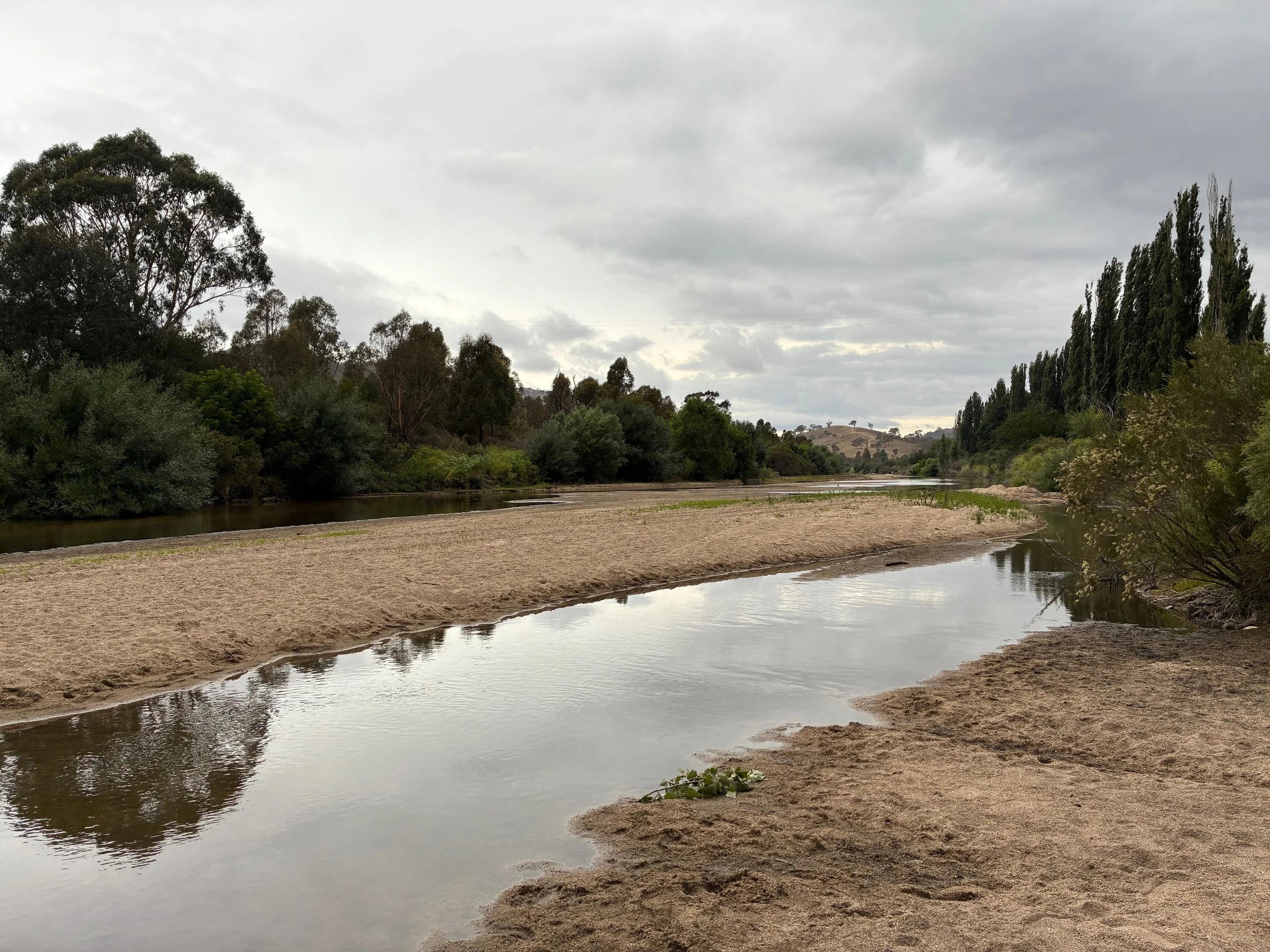
The Upper Murrumbidgee dried to pools and sandbars in late 2025 despite funding and frameworks secured for the river.
Transparency as a minimum standard
The history of the Upper Murrumbidgee shows environmental decline occurs when decisions are unclear and accountability fades. The central failure was not policy design but governance in practice. Implementation still relies on human decisions, when drought provisions are triggered, how much water is released and why - transparency becomes the safeguard that turns policy into protection.
From this point forward, those decisions must be public, evidence-based and open to scrutiny. That is not an unreasonable demand; it is the minimum standard of good governance. The Forgotten River campaign exists to ensure history does not repeat itself. The river has already endured the consequences of good policy poorly applied.
This time, the commitments must be seen as well as written. We can’t accept protection on paper that disappears in practice.
References:
McGuire, A. & Pittock, J., 2025, Environmental Flows in the Upper Murrumbidgee River: Evaluating flow delivery and governance to inform future environmental flow agreements, Marine and Freshwater Research 76.