
Economist calls for transparent and fairly priced mechanisms for Tantangara releases
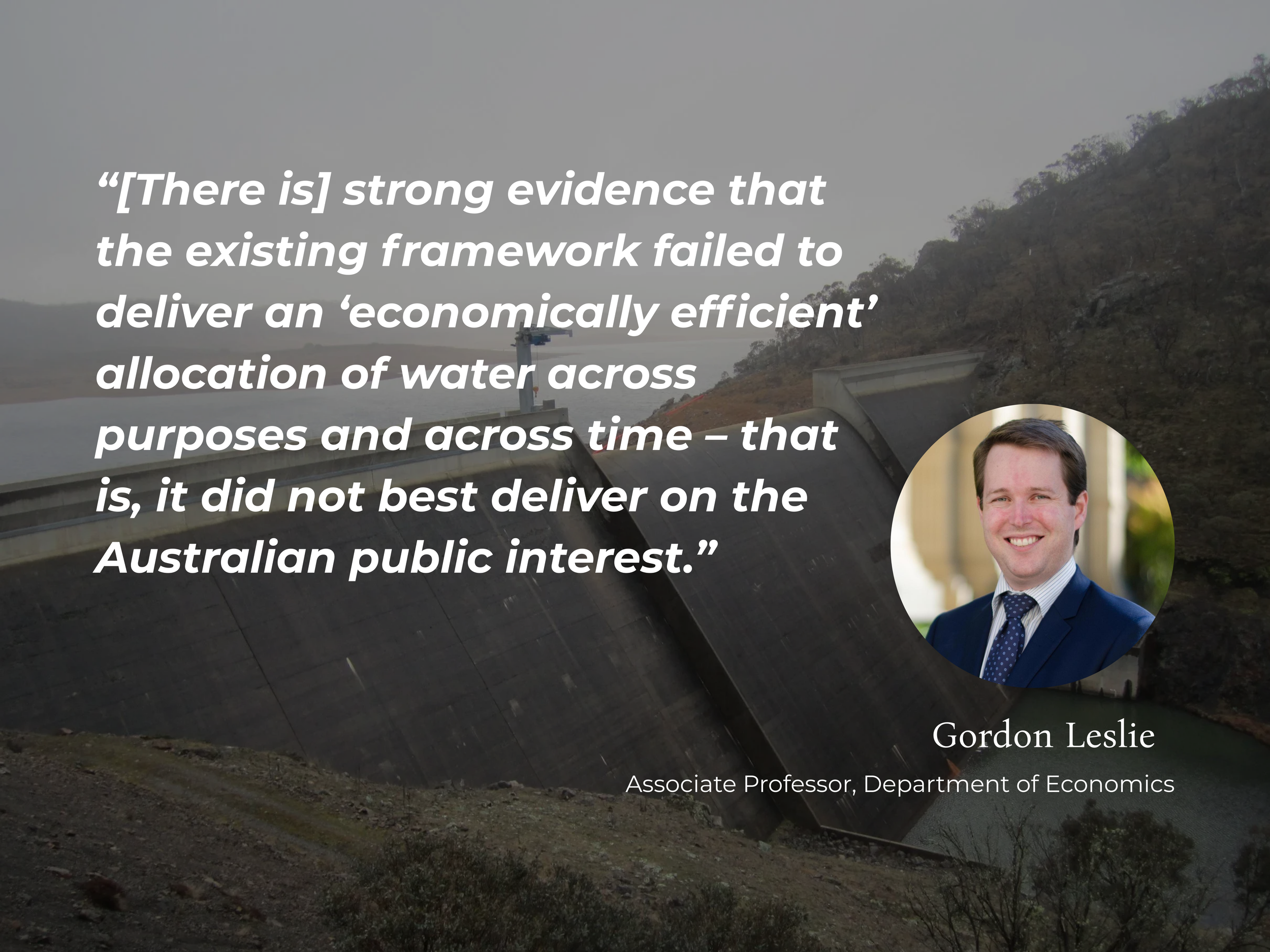
As part of the consultation on the Draft Upper Murrumbidgee Drought Operating Framework, Associate Professor Gordon Leslie, an energy economist from Monash University, has lodged a detailed submission outlining economic principles for determining how water in Tantangara Reservoir is best allocated across multiple potential uses.
While his expertise lies in economics and public policy rather than ecology, his conclusion is highly relevant to the future of the Upper Murrumbidgee: the current regulatory framework does not facilitate additional discretionary, high-value environmental water releases when conditions change.
His full submission is available here:
“Water has multiple competing values”
A/Prof Leslie frames the issue as one of institutional design. In his submission, he writes:
“Water has multiple competing values: It can be used for electricity generation, the environment, irrigation, recreation, or drinking water.”
The central economic question, he argues, is whether the rules governing water releases allows for water to be allocated efficiently across these uses as circumstances evolve. Stored water has an option value because it can be released at a later point in time to realise value from those uses.
The consequence of releasing any additional water to the Upper Murrumbidgee is that there is less stored water in Tantangara Reservoir, which results in a decrease in the potential electricity revenues that can be earned by Snowy Hydro Limited (SHL). An efficient framework would weigh whether the public benefits of such a release exceed the option value that is lost from keeping that water stored. He emphasises that both these values can change significantly throughout a year, so a flexible release framework is needed to make best use of the water.
December 2019 as evidence of failure
The December 2019 cease-to-flow event features prominently in his submission. He describes it as:
“[There is] strong evidence that the existing framework failed to deliver an ‘economically efficient’ allocation of water across purposes and across time – that is, it did not best deliver on the Australian public interest.”
The submission does not attribute blame to individuals or agencies. Instead, it focuses on the design of the institutions governing water releases.

Upper Murrumbidgee River during the 2019 cease-to-flow event. Photo credit: Simon Lowes.
Challenges in designing water release compensation can be avoided
The Draft Upper Murrumbidgee Drought Operating Framework proposes discretionary water purchases from SHL during drought conditions. A/Prof Leslie discusses the merits of the options proposed but makes the key point that the challenges might be sidestepped by effective within-Government coordination:
The Draft Upper Murrumbidgee Drought Operating Framework suggests the government could buy water from Snowy Hydro Limited during droughts. A/Prof Leslie points out that the problem might be solved more easily if different government departments coordinated better with each other.
“It should be investigated whether it is suitable for the Shareholder Ministers of SHL to require SHL disclose their internally calculated water values in a verifiable manner to the regulator. This can facilitate efficient transfers of water to the Upper Murrumbidgee. An Australian government agency using Australian government / public funds to compensate an Australian government-owned entity for water releases can be much more simply and accurately facilitated within government than via the approach suggested in [the draft framework].”
Flexibility beyond drought, and into the future
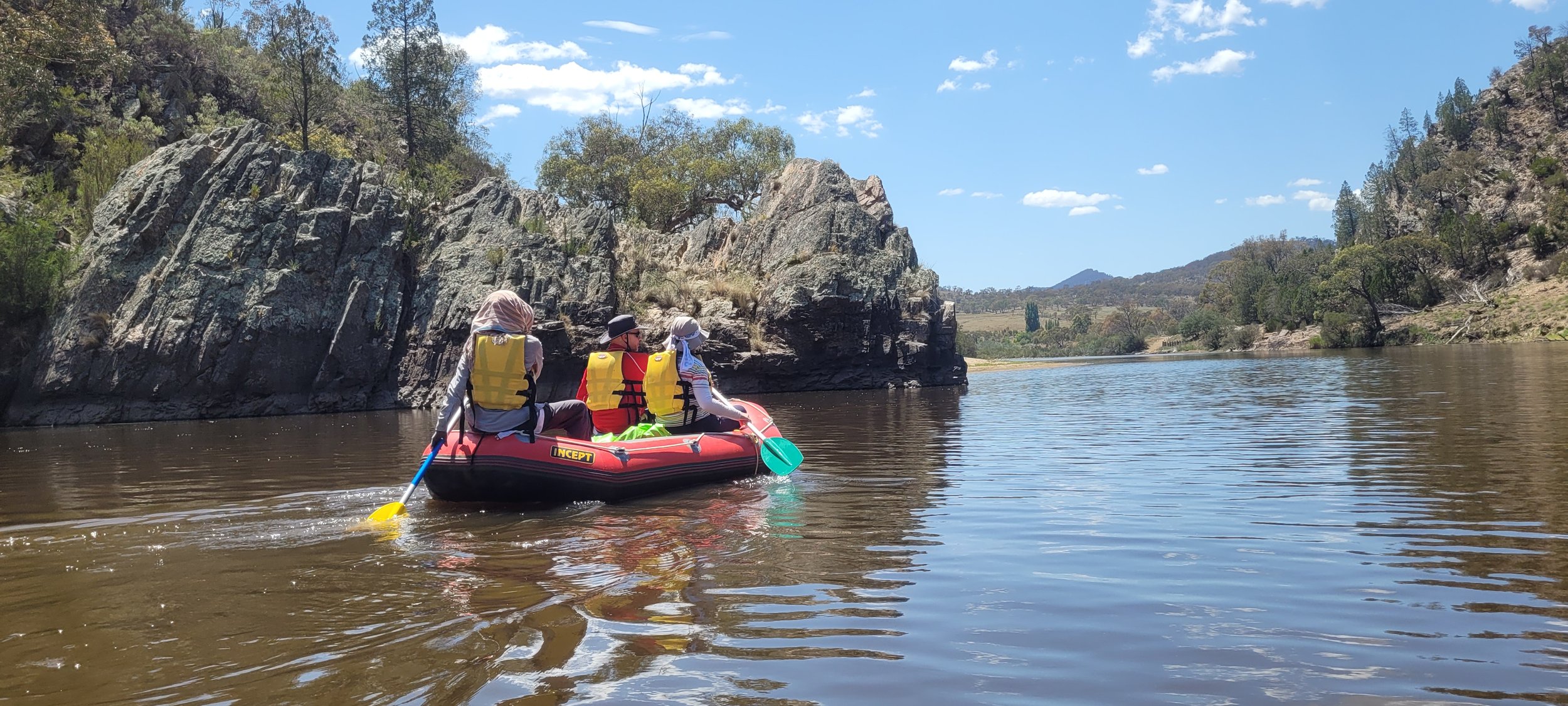
The Upper Murrumbidgee isn’t always in drought but nonetheless needs our attention and long term strategy instead of short term fixes.
Although the draft framework focuses on drought conditions over the next three years, A/Prof Leslie’s submission calls for a longer-term, multi-case mechanism:
“It should be a policy priority to develop a longer-term and multi-case mechanism… that allows for a more efficient allocation of water at any time, not just drought conditions.”
From his economic perspective, the issue is clear: the events of 2019 demonstrated that the system lacks sufficient flexibility. A transparent, rule-based mechanism for discretionary releases would be a significant step toward ensuring that water in Tantangara can be used where it delivers the greatest benefit to society - including the Upper Murrumbidgee when it needs it most.
As we begin to shift gears, we would love for you to continue on this journey with us by staying up-to-date via The Forgotten River newsletter, where you will be the first to know of opportunities to stand up for this river.
References:
Leslie, G. W. (2025). Submission to the Draft Upper Murrumbidgee Drought Operating Framework. Monash University.
Leslie, G. W., Arzhintar, D., Neill, K., & Wyrwoll, P. (2025). Inferring the Value of Stored Water in Hydroelectric Schemes. Monash University, Department of Economics (SSRN Working Paper).