

SWIOID Review and Updates
In November 2025, the review of the Snowy Water Inquiry Outcomes Implementation Deed (SWIOID) moved from promise to a live, structured decision-making process – and the Upper Murrumbidgee community finally has a seat at the table.
Learn more about the SWIOID Review below or head straight to the latest updates.
What is the SWIOID Review?
The SWIOID is an important document. It establishes the amount of water available to the upper Murrumbidgee River, as well as the other rivers of the Snowy and Montane region. The volumes of water it allows for rivers is then enacted through the Snowy Water Licence.
The SWIOID is an Intergovernmental Agreement between the NSW, Victorian and Australian governments. It was signed in 2002 has not been reviewed since.
Reviewing this document is critical to the survival of the upper Murrumbidgee River. In 2025 the Australian Government formally opened a review of the Snowy Water Inquiry Outcomes Implementation Deed (SWIOID) – the 2002 intergovernmental agreement that sets how much water is released from the Snowy Scheme to the Snowy, Murrumbidgee and montane rivers.
The review has two big aims:
Improve the health of the Upper Murrumbidgee River upstream of Burrinjuck Dam, while recognising the importance of all Snowy and montane rivers.
Bring the Deed into line with contemporary water, climate and energy policy, including the Murray–Darling Basin Plan, climate resilience goals and expectations for Snowy Hydro as a publicly owned renewable energy company.
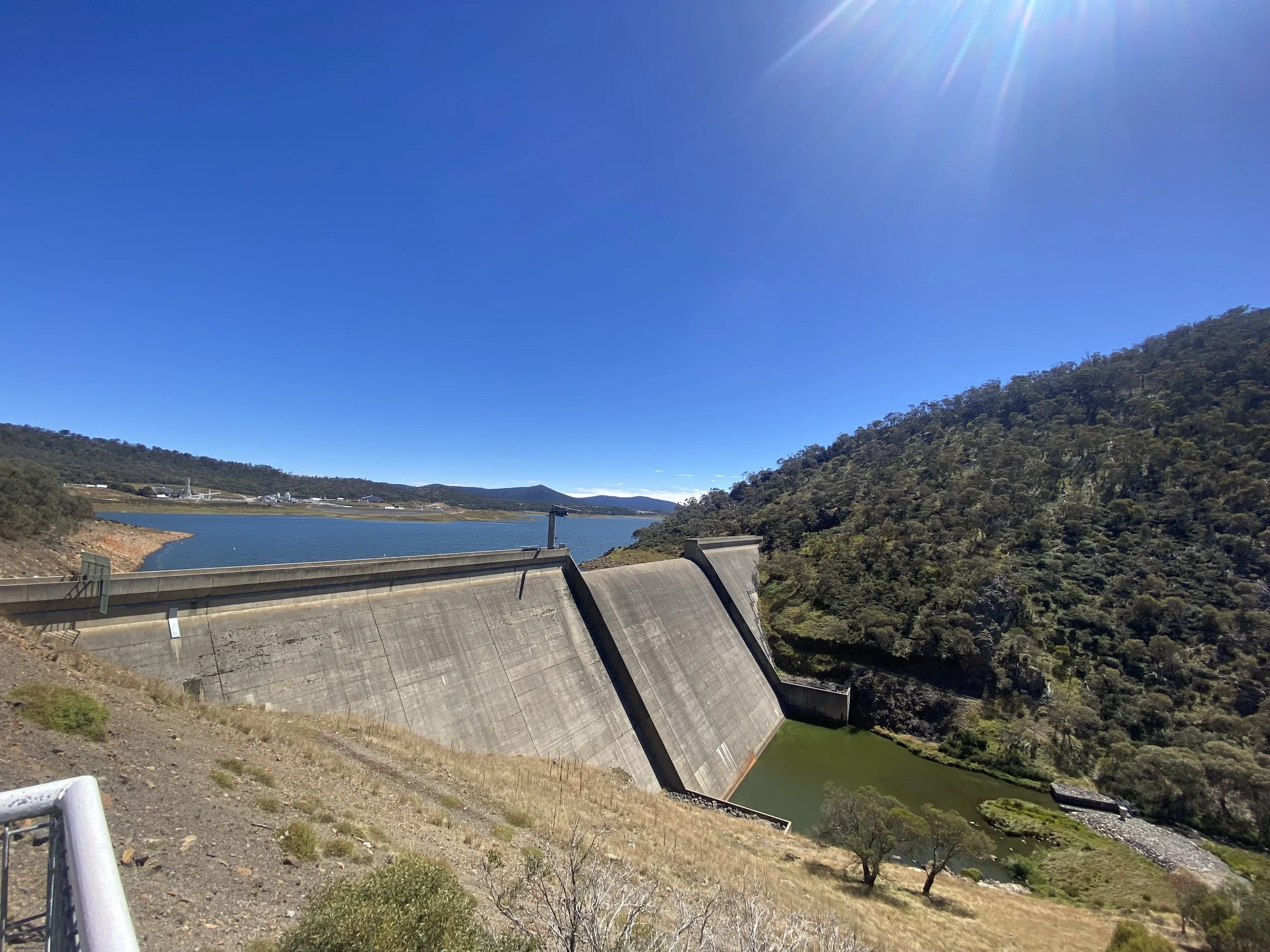
For The Forgotten River community, this is the first time in more than 20 years that the rules controlling flows from Tantangara Dam – which can capture more than 90% of the river’s headwaters in many years – are being reconsidered.
Using a structured decision-making process
Rather than a closed technical review, governments have committed to using Structured Decision Making (SDM) – a collaborative planning framework designed for complex, high-stakes decisions.
In simple terms, SDM helps everyone work through five linked questions:
Decision context – What are we really deciding about?
Clarifying the problem, the scope of the review and the real constraints.Objectives & performance measures – What do we want?
Agreeing on shared objectives for river health, First Nations values, community wellbeing, water security and energy, and choosing measures we can use to track how well different options meet those objectives.Alternatives – What can we do?
Developing different management options – for example, alternative flow releases from Tantangara Dam, drought carryover rules, or infrastructure and operating changes – rather than treating the current rules as the only option.Consequences & trade-offs – What will happen, and what do we prefer?
Using hydrological, ecological, cultural, social and economic analysis to understand the consequences of each option and the trade-offs between them (for example, river health vs energy flexibility vs downstream water use).Implement, monitor & learn – How do we adjust over time?
Building in adaptive management so rules can respond to changing climate, catchment and electricity market conditions rather than locking in a 2002 view of the world.
This process will run over several rounds of workshops, modelling and refinement between late 2025 and mid-2026, with communities and First Nations able to see how information and values are influencing the final recommendations.
Who’s involved?
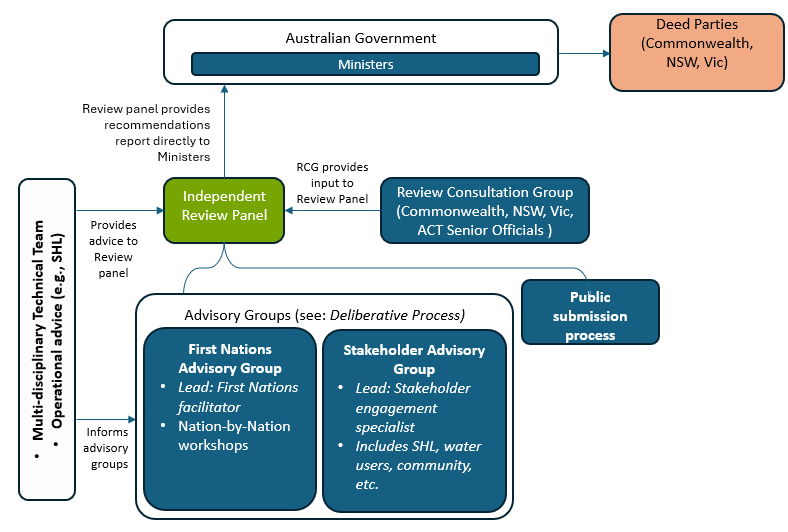
The governance diagram from the SWIOID Review Framework shows how different groups fit together:
Independent Review Panel (IRP) – three experts in water, environment and energy who lead the review and make recommendations to Australian Government ministers. They consider all technical work and advice from advisory groups and public submissions.
Deed Party Ministers & Governments – the Commonwealth, NSW and Victorian ministers who must jointly agree any changes to the Deed. The ACT Government participates through an intergovernmental committee, recognising its strong stake in Upper Murrumbidgee flows.
Review Consultation Group (RCG) – senior officials from the Commonwealth, NSW, Victoria and ACT who coordinate between jurisdictions and advise on policy and regulatory issues.
Multi-disciplinary Technical Team – specialists in hydrology, ecology, energy, economics and communications who provide the modelling and analysis used in the SDM process.
First Nations Advisory Group (FNAG) – Wolgalu, Ngunnawal, Wiradjuri, Ngambri and Ngarigo representatives who centre cultural values, guide how Traditional knowledge is used, and advise on cultural water, rights and river health.
Stakeholder Advisory Group (SAG) – 18 members representing community groups, recreational fishers, conservation organisations, irrigators and other water users, local government, urban water utilities, scientists and Snowy Hydro Limited. Their job is to work through the SDM process and provide considered, broadly supported recommendations on flow and management options. Forgotten River campaigners include Dr Siwan Lovett from the Australian River Restoration Centre.
Public submissions / Have Your Say – a public process (opening in late 2025) for anyone to provide input, which the IRP will consider alongside advice from the advisory groups.
How the process will roll from here
The review is structured around four SAG workshops running from November 2025 to March 2026, supported by FNAG meetings, technical work and public consultation in between.
A simplified timeline looks like this:
October–November 2025 – Getting started
Pre-work to develop preliminary ecological measures and first-round flow alternatives.
One-on-one interviews and an introductory webinar for SAG members.
Workshop 1 (11 November 2025) – Problem, objectives and early options
Introduce the SDM process.
Share the hydrology and current condition of the Upper Murrumbidgee and how the Snowy Scheme operates.
Discuss preliminary objectives and performance measures, and explore first flow scenarios.
Between Workshops 1 & 2
Technical team models the first set of alternatives.
Webinars on environmental water requirements and modelling assumptions, and on Snowy Hydro operations and UMR flows.
Workshop 2 (December 2025) – Initial trade-offs
Review early modelling results.
Refine broader social, cultural and economic measures and flow options.
Workshops 3 & 4 (February–March 2026) – Preferred options and advice
Consider full integrated modelling.
Identify preferred and hybrid options, note areas of agreement and disagreement, and finalise advice for the IRP.
The IRP will then pull together all evidence and advice – from FNAG, SAG, governments and the public – and provide recommendations to government by mid-2026.
To be as transparent as possible, and to provide anyone who is interested with the details of this process, we will publish the results of all meetings on this website. We want you, as someone who cares about the Upper Murrumbidgee and montane rivers, are kept up to date with SWIOID Review we have all worked so hard to achieve.
Review Updates
Tharwa (ACT) 18th December 2025