

Recovering The Forgotten River
Our campaign to raise awareness about the Upper Murrumbidgee has been effective - but we have to keep the pressure up
Back in 2023 we created a proposed way forward for the Upper Murrumbidgee, and we are so delighted that since then:
The Australian Government has committed significant funding to river restoration and drought response.
A formal review of the Snowy Water Inquiry Outcomes Implementation Deed (SWIOID) is underway for the first time in more than two decades.
A national Upper Murrumbidgee River Health Strategy has been released.
New frameworks like the Drought Operating Framework and planning tools have been developed to guide future water management decisions.
These are important milestones and twe extend a heartfelt thank you to everyone who has spoken up for the Upper Murrumbidgee River - your persistence has mattered.
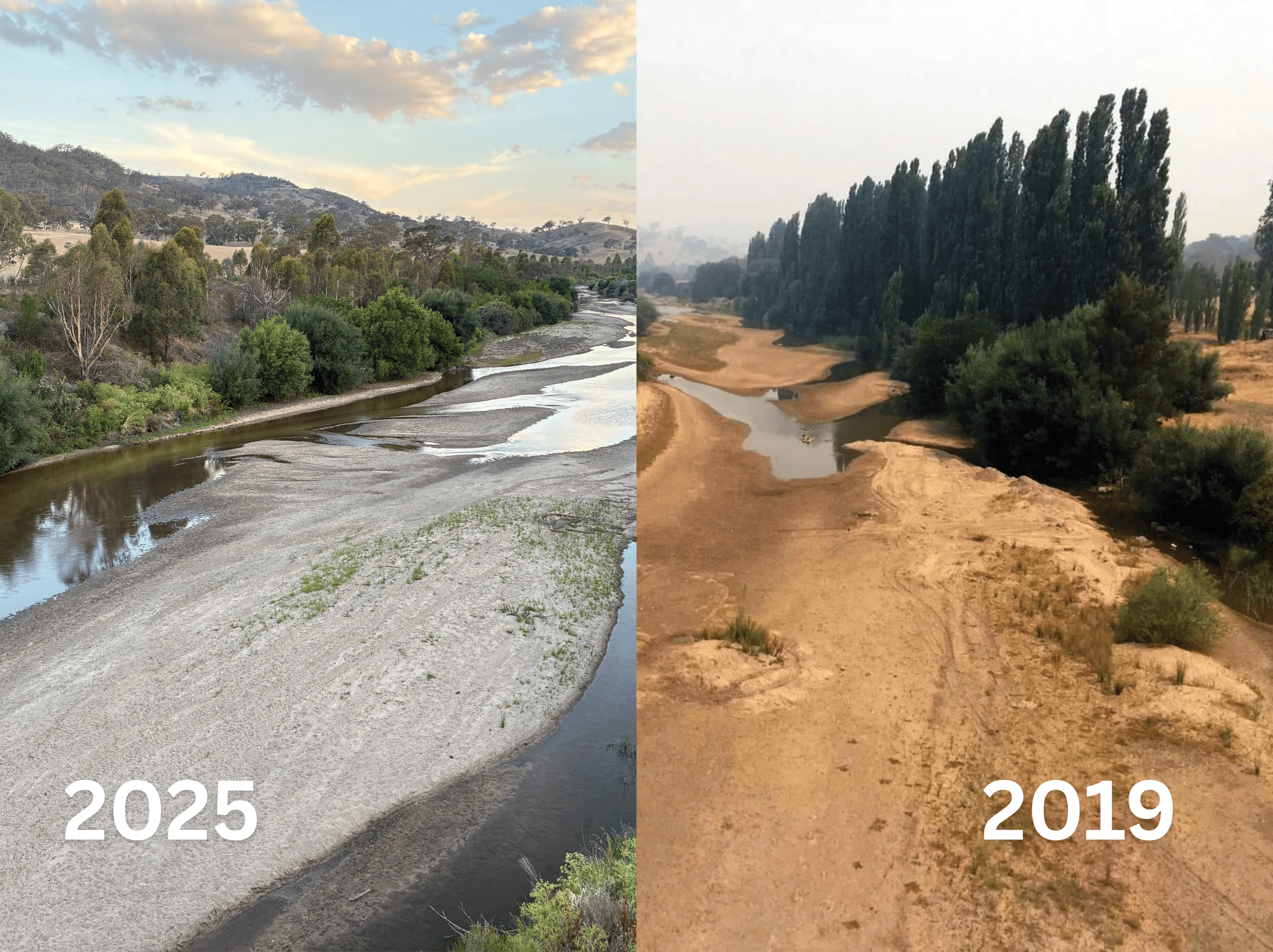
Unfortunately progress on paper has not yet translated into progress in the river.
While money has been committed and frameworks have been written, much of the funding remains unspent, and critical tools, including the Drought Operating Framework, have not been used when the river needed them most. This gap between commitment and delivery is why we are now saying: this is taking too long.
Why has progress been so slow?
Despite up to $55.6 million being allocated for Upper Murrumbidgee restoration, drought response and governance reform, much of this funding is still sitting unused. Complex federal funding agreements, layered approval processes and unclear accountability between governments have slowed on-ground delivery.
Most concerning is what has happened during recent low-flow and drought conditions.
Around $30 million was specifically set aside to support drought contingency releases from Tantangara Dam to protect aquatic refuges and prevent irreversible ecological damage when flows dropped below critical thresholds. Those triggers were met, yet the water was not released. The money remained in the bank while the river continued to suffer.
It seems that the involvement of multiple agencies across the Commonwealth, NSW and ACT has created delays, with limited public reporting on timelines, spending or delivery milestones. The result is understandable community frustration and one clear question:
Why is it taking so long when the need is urgent and the funding exists?
Why we need your continued support
The commitments made so far are significant — and worth protecting. But history shows that without sustained public scrutiny, good intentions can stall.
We cannot afford a situation where:
drought frameworks exist but are not used,
funding is allocated but not spent, and
decisions are delayed until damage is already done.
This campaign has already shown what community pressure can achieve. Now we need to keep it up, to ensure transparency, timely action and real outcomes in the river itself.
That means:
clear public reporting on where money is being spent and when,
faster activation of drought-response tools when triggers are met,
delivery of on-ground works at a scale that matches the challenge, and
continued First Nations leadership and community involvement in decision-making.
The river has waited long enough.
Steps we must take going forward
-
We need politicians and community champions to demand better quality and quantity of flows in the river for environmental, social and cultural outcomes. As a source of drinking water for our region, a healthy and reliable river is critical to our communities.
We don’t want the Upper Murrumbidgee River to die, so we must act now so that we can protect and restore this Forgotten River for now and for generations to come.
-
We need the existing environmental water allocated for the Upper Murrumbidgee to be legally protected in the system. This includes changes to rules in the Murrumbidgee Unregulated Water Sharing Plan, so that measuring, metering, and compliance is used to ensure there is no unlawful take of water.
We need the volume of water available for the environment to be increased, based on the best available science, to determine what the river needs for ecological health. This should start with an open and transparent review of the Snowy Water Inquiry Outcomes Implementation Deed. Please look at the Issues Paper on the Deed and provide your comments here.
-
We need the existing environmental water to be managed in-line with best practice, based on best available information, and applying the principles for environmental water management under the Murray Darling Basin Plan.
We need regional water agencies and utilities to understand and advocate for ongoing water quality and security for the region, especially under a changing climate. This includes Icon Water, which relies on the Murrumbidgee as a third source of water for the Australian Capital Territory.
-
The community needs Snowy Hydro to demonstrate their commitment to environmental, social and Cultural outcomes for the river as part of their current operations, and into the future as part of Snowy 2.0. This nation-leading project should also be a world-leader on achieving environmental, Cultural and social outcomes.
We need a process which opens up SnowyHydro’s license and water management framework to public scrutiny, allowing examination of whether the current licence conditions are adequate for the river and for regional water security. This should start with an agreement by NSW, Victorian and Commonwealth governments to an open and transparent review of the Snowy Water Inquiry Outcomes Implementation Deed which is now underway and to which you can contribute here.
-
We need broader community education about the importance of the river to our region and the complex management arrangements involved.
We are currently on the Stakeholder Advisory Group for the review of the Snowy Water Inquiry Outcomes Implementation Deed and your comments are welcome on the recent Issues Paper released by the Independent Expert Panel on the changes that need to be made. You can put your submission in here.
-
For the review of the Murray Darling Basin Plan in 2026, our region must seek the inclusion of the Upper Murrumbidgee River as a hydrological indicator site to measure basin flows and health. This site needs to be able to monitor the river at critical low-flow periods
Given the state of the Upper Murrumbidgee River, more investment is required to protect threatened species such as the Macquarie Perch.
We have money for flows and complementary measures to try and protect and restore the river - but it is not being spend and we need to know why?
-
The Upper Murrumbidgee River needs to have a long-term, coordinated, interdisciplinary monitoring program to understand the water quality and ecological condition and changes over time. This should look to coordinate existing programs and bolster ecological monitoring across NSW and ACT reaches of the river.

“The Upper Murrumbidgee is a very special place containing the best Macquarie perch population in Australia. I want my grandkids to be able to explore and enjoy it, just as I have for the past 40 years. If we don’t act now to protect its unique aquatic resources and values, we condemn it to a slow but inevitable decline.”

Assoc. Prof Mark Lintermans
Centre for Applied Water Science,
University of Canberra
What practical steps can I take today?
-

Learn more about the issue
Thank you for taking the time to look at this website. To help you learn more about the issues, we have curated a list of reports, articles and media.
-

Start the conversation among your networks
Let’s increase informed conversations! Talk to your friends, family, colleagues – even your local coffee shop – about the issue and spread the word.
Copy this page’s address and email your friends now!
-

Voice your concerns with local politicians
There has been a lot of progress on steps to recover the upper Murrumbidgee River. However, the river will always be under threat while there are not enough flows. The only way to fix this is for the SWIOID review to proceed in an open and transparent way, to restore better flows to the river. The SWIOID review is vital! Have yout say on the Indendent Expert Panel Issues Paper on the state of the Murrumbidgee now.
-

Subscribe to our updates to stay in the loop
‘The Forgotten River’ website has been established to put ongoing pressure on the Federal Parliament to bring the Snowy Hydro scheme into the Water Act 2007. Please subscribe for regular updates on the progress and actions being taken.